
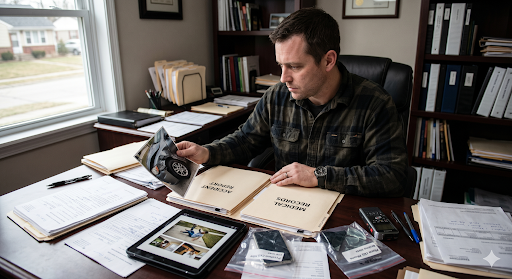
The Evidence That Wins Your Case Has a Shelf Life
Let me tell you what I see constantly in online forums and comment threads: someone posts about a slip-and-fall or a rear-end collision, and within minutes, a chorus of strangers tells them their case is hopeless because they don’t have video footage. No dashcam? Forget it. No witnesses who stuck around? You’re done. I spent years on the insurance-defense side watching adjusters exploit exactly this kind of discouragement. The myth that only a smoking gun wins cases is one of the most damaging pieces of misinformation circulating out there — and it costs real people real money.
Most successful personal injury claims are built from layers, not a single dramatic piece of proof.
The Smoking Gun Myth (And What Actually Wins Cases)
Insurance companies benefit when you believe your evidence is insufficient. An adjuster’s early “we can’t verify liability” response is often a tactic, not a verdict. I’ve watched defense teams work with far thinner evidence than most claimants actually possess.
What wins cases isn’t one perfect piece of proof. It’s consistency. A timeline that holds up. Medical records that align with the mechanism of injury. An accident report that places the other party at the scene. Witness details that corroborate your account. Each element reinforces the others, and together they create a version of events that becomes very difficult to dispute.
The other myth worth killing quickly: that you needed to act in the first 24 hours or everything is lost. Some evidence does disappear fast — I’ll get to that — but many forms of documentation remain available weeks or even months later. You’re not automatically behind. What matters now is understanding what you still have and what you need to move on immediately.
What “Fault” Actually Means in Legal Terms
People use the word “fault” casually. In a personal injury claim, it has a specific legal architecture.
Standard negligence theory requires proving four elements. Every piece of evidence you collect should be doing work toward one of them.
| Element | What It Means | Where the Fight Happens |
|---|---|---|
| Duty of care | The other party had a legal obligation to act safely toward you | Rarely contested — drivers, property owners, and employers all carry established duties |
| Breach | They failed to meet that obligation | This is the primary battleground — what they did wrong and why it matters |
| Causation | Their breach directly caused your injury | Insurers attack here, suggesting pre-existing conditions or disputing severity |
| Damages | You suffered something compensable | Without documented harm, even a clear breach doesn’t produce a viable claim |
Liability is the broader concept that wraps around all of this. When liability is established, it means the other party is legally responsible for what happened to you. Negligence is the theory you use to get there. Understanding this distinction helps you see why evidence collection isn’t random — every document, every photo, every statement is building the case that this specific person or entity is liable for your specific harm.
One element deserves extra attention: causation. This is where insurance companies love to create doubt. They’ll suggest your back pain was pre-existing, that you would have been hurt anyway, or that the accident wasn’t serious enough to cause your injuries. Your medical records — especially early ones — are your primary defense against this argument. Getting medical attention promptly matters not just for your health, but because treatment records create the paper trail that ties your injury to the incident.
The Evidence Hierarchy: What Carries the Most Weight
Not all evidence is created equal. When you’re scrambling to document a situation from your phone in a hospital waiting room, you need to know what to prioritize.
Tier 1 — Hardest to dispute:
- Official accident reports — Created by a neutral third party at or near the time of the incident. A police report captures the officer’s observations, any citations issued, road conditions, and often a preliminary fault determination. An incident report from a store or workplace creates an official record that the event happened at all, which matters enormously when the other side later claims they have no knowledge of it.
- First medical treatment records — The ER visit, urgent care note, or primary care documentation establishes your baseline. It captures what you reported, what was observed, and when. Every subsequent record builds the continuity of your injury.
Tier 2 — Powerful but time-sensitive:
- Photographs and video — Their value drops fast. Evidence preservation guidance is clear: physical conditions change quickly. A broken stair gets repaired. A dented vehicle gets fixed. A wet floor gets mopped. Photograph the scene, the hazard, the damage, and your visible injuries immediately.
- Witness accounts — A person who saw what happened and is willing to say so carries real weight, especially when their account aligns with your own. Preserving witness contact information — name, phone, email — should happen at the scene if at all possible.
Tier 3 — Fills gaps when other evidence is thin:
- Expert testimony — When the cause of injury is genuinely complex — a multi-vehicle collision, a workplace machinery failure, a fall with disputed conditions — expert testimony from specialists like accident reconstructionists or medical professionals can fill evidentiary gaps that lay witnesses cannot.
- Your personal injury journal — Informal but underestimated. Running notes about symptoms, limitations, and how the injury has affected your daily life directly support the damages portion of your claim.
Building Your Documentation Layer by Layer

Think of your claim as a structure that needs multiple load-bearing walls. Here’s how to build them, even if you’re starting late.
Write a timeline today — before anything else. Sit down and document everything you remember: the date, time, location, what you were doing, what happened, what you saw, what was said, and who was present. Include weather, lighting, and any conditions that seem relevant. Do this before you talk to an insurance company, before you post anything on social media, and before the details blur further. This document becomes your anchor for everything that follows.
Request every official record in writing. Police report, store incident report, employer injury log. Keep copies of the requests themselves, not just the records. If a report was never filed and should have been, that absence can be documented and addressed — but only if you’ve made a formal request that creates a paper trail.
Organize your medical documentation systematically. Every bill, every diagnosis, every treatment note. If you’ve been seen by multiple providers, request records from each. Gaps in treatment are something adjusters actively look for, so consistent follow-through with medical care isn’t just about healing.
Preserve physical evidence before it disappears. The clothes you were wearing. A defective product. A piece of broken equipment. Don’t repair your vehicle before it’s been documented and inspected. Don’t discard anything that shows damage. Short preservation windows mean physical items can disappear or get altered with alarming speed.
Log every insurance company interaction. Every call, every letter, every email. Note the date, the name of the person you spoke with, and what was said. Adjusters’ statements and their handling of your claim can become relevant later — in ways that aren’t always obvious at the time.
When Key Evidence Seems Missing
The question isn’t whether your evidence is perfect. It’s whether what you have is consistent — and whether you’ve identified what can still be recovered.
What if you didn’t get photos? What if no one stopped to give you their name? What if the accident report has errors?
These are real problems. They’re rarely fatal.
Q: I didn’t photograph the scene. Is that evidence gone? Not necessarily. Return and photograph the location now — even current photos establish geography and context. Check whether nearby businesses have exterior cameras. Request traffic camera footage from the municipality. These requests have deadlines, so move quickly, but the window hasn’t always closed.
Q: There were no witnesses, or no one stayed. Your own testimony is evidence. So is the physical evidence of the impact itself. So are the medical records that document the injury. A claim without witnesses is harder, not impossible. The consistency of your account across all documentation carries more weight than most people realize.
Q: The accident report has errors or missing information. You can submit a written correction or supplemental statement to the reporting agency. An attorney can help you challenge specific findings. One officer’s preliminary notation is not the final word on fault — it’s a starting point that can be contested.
Q: The other side is raising my pre-existing conditions. This is one of the most common tactics used to undermine injury claims. The legal standard isn’t that you were perfectly healthy before the incident — it’s that the incident aggravated or worsened your condition. Medical records showing the difference between your baseline and your post-incident status are what matter here. “Pre-existing” is not a disqualifier.
The Statute of Limitations Problem Nobody Talks About Enough
Here’s the piece most online advice skips over entirely.
Evidence doesn’t just degrade — your legal right to use it does too. Every state sets a deadline for filing a personal injury claim, and once that window closes, it doesn’t matter how strong your documentation is. The statute of limitations isn’t a technicality. It’s a hard stop.
This is why the “I’ll deal with it later” approach carries real risk. Not because your evidence will necessarily disappear, but because your ability to act on it will. If you’re in Massachusetts and navigating any of these complications — missing evidence, disputed reports, pre-existing condition arguments — a personal injury attorney boston can help you assess what you have and identify what’s still recoverable before that deadline becomes an issue.
Your Next Concrete Steps
You don’t need a perfect file to take action. You need a working one.
- Write your timeline today — before another day blurs the details
- Request your accident report this week — in writing, with a copy of the request
- Gather every medical record you have — and identify what’s missing from the sequence
- Photograph anything that still shows damage or hazard — even now, context matters
- Contact any witnesses — ask if they’d be willing to provide a statement
- Start a daily injury log — symptoms, limitations, how your life has changed
Then stop second-guessing whether what you have is enough and start building toward what you need. The evidence that wins cases isn’t always dramatic. It’s consistent, documented, and organized — and that’s something you can still create, starting right now.
About the Author